
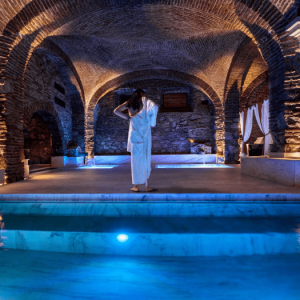


“Roman baths were born as much more than a simple hygiene habit…”
Meet the Roman bath experiences No, at Acqua Veritas Spa in Évora.
The origin of Roman baths
Roman baths were born as much more than a simple hygiene habit. In Ancient Rome, bathing was a complete ritual: physical, social, and even spiritual. It was a moment of pause, meeting, purification, and renewal. Centuries later, this practice still makes sense because it responds to a deeply human need: to slow down.
A traditional Roman bathhouse was a complex of rooms with different temperatures and functions. Visitors would typically begin in a *tepidarium* (warm room) to acclimatise, then move to the *caldarium* (hot room) for sweating and cleaning. They might then go to the *frigidarium* (cold room) for a bracing dip, or to the *sudatorium* (a hot, dry steam room) for a more intense sweat. Beyond the bathing itself, Roman bathhouses were important social centres. They often included: * **Palaestra:** An outdoor exercise yard for wrestling, weightlifting, or ball games. * **Apodyterium:** The changing room where bathers would leave their clothes and have them guarded. * **Unctuarium:** A room for anointing the body with oils. * **Bibliothecae:** Libraries where reading and discussion could take place. * **Tabernae:** Shops selling food, drink, and other goods. * **Gardens and Relaxation Areas:** Spaces for quiet contemplation or conversation. The heating system was a marvel, with the *hypocaust* system circulating hot air from a furnace beneath the floors and through the walls, keeping the rooms at the desired temperatures. Water was supplied via aqueducts and heated in large boilers.
In a traditional Roman bath, the experience was constructed through different temperature environments. The body would pass through hot, warm, and cold zones, allowing for a gradual sensation of relaxation, activation, and revitalisation. More than just “bathing”, it was about preparing the body and mind for a state of equilibrium.

From ancient rituals to the contemporary concept of the spa
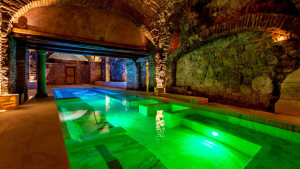
Today, Roman baths are returning, reinterpreted by the contemporary concept of the spa. The hot water, silence, and immersive atmosphere create a sensory experience that distances us from the daily noise. It is precisely this combination of history and well-being that makes Roman baths so current.
Why are Roman baths still relevant today?
We live in a fast-paced time, marked by an excess of stimuli, screens, notifications, and haste. The Roman ritual proposes the opposite: time, presence, and awareness of the body. Upon entering a Roman bath space, one seeks not just to relax, but to recover a more tranquil relationship with one's own rhythm.
Water, heat, silence, and time: the essential elements of the ritual
The relevance of Roman baths lies, therefore, in their simplicity. Water, heat, silence, and time continue to be essential elements for human balance. In a Roman-inspired spa, every detail can transform a visit into a memorable experience: not just for the comfort, but for the feeling of having returned to something ancestral.
Book a wellness experience inspired by ancient Roman baths.
Roman baths in Évora: an experience with ancestral inspiration
Roman baths are, at their core, an elegant way of remembering that well-being is not a modern invention. It's an ancient necessity that lives on.
At Acqua Veritas Spa in Évora
Experience inspired by ancient Roman baths
Discover a wellness ritual where water, heat, silence, and time come together for a memorable experience.
Frequently asked questions about Roman baths
The Roman baths were public bathing complexes that were an integral part of Roman society and culture. More than just places to get clean, they were social centres where people could exercise, relax, conduct business, and socialise.
Roman baths are experiences inspired by ancient Roman rituals, where water, heat, silence, and time create a sense of balance and well-being.
A traditional Roman bathhouse was a complex of rooms with different temperatures and functions. Visitors would typically begin in a *tepidarium* (warm room) to acclimatise, then move to the *caldarium* (hot room) for sweating and cleaning. They might then go to the *frigidarium* (cold room) for a bracing dip, or to the *sudatorium* (a hot, dry steam room) for a more intense sweat. Beyond the bathing itself, Roman bathhouses were important social centres. They often included: * **Palaestra:** An outdoor exercise yard for wrestling, weightlifting, or ball games. * **Apodyterium:** The changing room where bathers would leave their clothes and have them guarded. * **Unctuarium:** A room for anointing the body with oils. * **Bibliothecae:** Libraries where reading and discussion could take place. * **Tabernae:** Shops selling food, drink, and other goods. * **Gardens and Relaxation Areas:** Spaces for quiet contemplation or conversation. The heating system was a marvel, with the *hypocaust* system circulating hot air from a furnace beneath the floors and through the walls, keeping the rooms at the desired temperatures. Water was supplied via aqueducts and heated in large boilers.
In a traditional Roman bath, the body would go through different temperature environments, including hot, warm, and cold zones, promoting relaxation, activation, and revitalisation.
Why are Roman baths still relevant today?
Roman baths remain relevant because they meet an ancient human need: to slow down, regain presence, and foster a more peaceful relationship with the body and with time.
Are Roman baths merely a historical experience?
No. Today, Roman baths are reinterpreted in the context of spas, creating a contemporary sensory experience of relaxation and well-being.
Where to have Roman baths in Évora?
At In Acqua Veritas Spa in Évora, you can experience an immersion inspired by ancient Roman baths, in an exclusive environment dedicated to well-being.
 Portuguese
  English
  Spanish
  French